

The Negative Process: A Lost Art in photography
A few of my paintings may seem unusual at first glance, and that’s because they’re rooted in a photographic process most people today have never experienced: 35mm film.
Just a couple of decades ago, we didn’t have digital cameras. We loaded a roll of film—usually 24 or 36 exposures—into a camera, closed the back, and shot in negatives. Light passed through the lens and chemically etched an inverted image onto the film: dark areas appeared light, colors were reversed, and everything was bathed in a deep, murky orange-brown tone. After shooting, you’d take the roll to a lab. In return, you’d get printed positive photos—the familiar images we recognize—and the original negatives on a strip of film.
That’s where my paintings begin.
I photographed my original drawings on 35mm film, developed the negatives, and then painted directly from those negatives—not the positive prints. The result (negatives) became the source material. Their strange, inverted colors and eerie tonal shifts are preserved in the final works. That signature reddish-brown haze? That’s the film itself, baked into the paint.
But it goes further.
By photographing the negative, printing a positive, then re-photographing that positive to make a new negative—and repeating the cycle—you create an infinite loop of transformation. Each generation alters color, contrast, and mood. Like a hall of mirrors, the image reflects endlessly, but here it also mutates. In some pieces, I introduced a literal mirror, flipping the negative to reverse the composition. Over repeated cycles, the image not only shifts in tone but flips back and forth through time, creating a visual echo that feels alive, unstable, and eternal. This isn’t digital manipulation. It’s analog alchemy—using a now-obsolete medium to explore how images age, distort, and remember themselves. What you’re seeing isn’t just a painting. It’s a photographic ghost, developed in pigment.
These paintings are not just technical experiments. They are metaphors for perception.
In prayer, I sometimes see pain or darkness in others—what feels like a negative. But I’ve learned: what appears inverted may actually be the light. A shadow can reveal grace. A wound can be a doorway. In my work, I often paint without knowing if what I perceive as “negative” is truly dark—or if it’s the positive, misunderstood.
More urgently, this inversion is a tool of power. Governments and cultural brokers use it to manipulate reality: take a truth, reverse it, forward, backwards, forward backwards, print the lie as fact, and repeat. The public learns to accept darkness as light, control as freedom, decay as progress. Each cycle distorts perception and generifies power and governmental size profit—financial, political, spiritual.

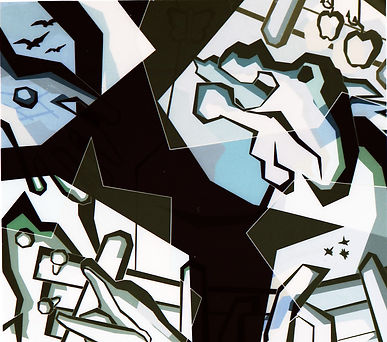
These paintings are quiet acts of resistance.
Most of culture remains blind to the deep, deliberate shifts in perception that ripple from the top down. This is how a government—or any power structure—can reach past the public square and infiltrate the walls of the family itself.
We are not, in large part, responsible for our wrongs. They are engineered, filtered down from a small, gifted cadre of manipulators who understand the negative-positive loop better than we do.
George Orwell saw it coming—before most of us were born.
He grasped the power of the cathode-ray tube (the glowing screen that would become television, then the internet, then the always-on feed). In 1984, he didn’t just warn of surveillance. He mapped the inversion engine: truth becomes lie, love becomes fear, freedom becomes obedience—each cycle reinforced by the screen’s endless pulse. Orwell predicted, almost to the day, the slow-motion collapse of Western clarity—not by tanks, but by cultural echoes, flipped and repeated until the negative feels like home.
These paintings are not decoration. They are diagnostic images of a civilization taught to see its own destruction as progress…look at the negative…hold it to the light and ask: who flipped the truth—and why do we keep printing the lie?
No one saw the negative-positive loop more clearly than Jesus Christ. Churches rightly proclaim that He died for our individual sins but He was also King of all twelve tribes of Israel—the two present at His crucifixion, and the ten scattered, declared “not My people,” only to be reclaimed at the appointed time. He did not come to abolish the heart of the Mosaic Law, but to end its distortion—centuries of legal words twisted back and forth, sideways into absolute confusion, seeping not just into culture, but fracturing families. In one heartbeat, He replaced it all with two commands that hold the whole Law:
Love God with all your heart.
Love your neighbor as yourself.
No more loopholes. No more manipulation. Yet 1,500 years later, even these simple truths hardened into Church ritual, and then 500 years later codified into U.S. Constitutional law. once noble words, then twisted again, into their current, inverted form. The same negative → positive → negative cycle— now weaponized through language. That’s the force of metaphor. People twist language to deny the obvious—
“There’s an elephant in the room.”It speaks it plainly: something massive is here that can’t be ignored.
Christ exposed the loop and then broke it—not just as the Son of God, but as the rightful King of all twelve tribes. The Church, for 2,000 years, has clung to the cross—the moment of death. Powerful, yes, but it risks burying the truth in the ground. Imagine instead: the Shroud of Turin as the central image—resurrection captured in light…. a flash—a billionth of a second—burned onto linen just like a negative in a 35 mm film cartridge. Not a corpse a living negative—projected into eternity.

In 1898, Secondo Pia, a respected Italian photographer, was granted rare permission to photograph the Shroud of Turin. On the positive image: a faint, murky figure—barely discernible. But on the negative plate? A face—vivid, detailed, undeniable. The image we now recognize as Christ’s.
Pia was accused of forgery. Ridiculed. His discovery dismissed as trickery. Fifty years later, in the 1930s and again in 1969–1973, others photographed the Shroud.
Each time, the same face emerged on the negative and not on the cloth. Two thousand years after the resurrection,
the same negative-positive loop—once a miracle of light—is weaponized again. This time, not to reveal, but to obscure.
In 1988, three laboratories (Oxford, Zurich, Arizona) cut a 7 cm × 1 cm strip from the Shroud’s lower corner—site textile experts had already flagged as a repair patch caused by a medieval fire. After carbon testing the strip they declared the shroud a forgery and not 2,000 years old. Another inversion. Another manipulation. Culture, faith, individuals—pushed from the light by a lie printed as truth. The same positive-negative loop, once flashed onto linen in resurrection light, now the opposite a positive turned into a negative now weaponized to keep power in place and bilked billions flowing. Truth buried by a medieval patch.
The Shroud is not just cloth. Its metaphor made visible: Death inverted into life. Darkness into revelation. Silence into eternal witness so we could see through the deception. My paintings follow that same light. They use the same loop—not to deceive, but to restore vision or to question truth. Look at the negative. See the face. The truth was never buried. It was developed in light— waiting for our own eyes to invert the lie.
And here, the perfect Christian metaphor—dark and light, negative and positive—all in one. My brother Jay, standing in the empty sarcophagus inside the Great Pyramid of Egypt. By chance, his silhouette mirrors the parable found on the Shroud of Turin. Jay’s accidental gift to mankind. The metaphor etched in stone on a piece of photographic paper. Christ was our first-fruits—His image burned onto linen in a billionth of a second the moment of his resurrection from the dead. So too, at the appointed time, the same flash will burn onto our shrouds too.

Every great Godly truth has been unmade by the skilled and the ruthless. The positive-negative miracle of the Shroud—light burned onto linen in a billionth of a second—is now used as a ritual in backward masking. Sacred dates like September 11, once a marker of divine rhythm—are forever stained by orchestrated terror. The heroic story of a migrating people, chosen, scattered, regathered is erased by “his-story” writers and then placed on cathode-ray tubes for the masses. Even the biblical timeline preserved in stone in the Great Pyramid—sole survivor of the Seven Wonders—is graffitied with lies, its measurements twisted, its purpose buried under centuries of deception and then ripped of its white polished outer casing. They don’t destroy the truth. They invert it—positive to negative, light to shadow—until the world learns to call the forgery real.
My paintings are not an attempt to reclaim—
they are questions I paint into the truths I once held as solid fact.

