My heart for art began in fifth grade.
I had an amazing teacher—Mrs. Saylor at Roland Elementary, in the late 1960s. America was racing to put a man on the moon by decade’s end, and that dream gripped me. Like so many boys then, I filled pages with Apollo rockets and escape pods, imagining one day lifting off this planet to explore new worlds.
But it wasn’t just the drawing that rooted it deep. It was drawing while Mrs. Saylor read to us. Her soft, sure voice carried entire books into the room. The first was Charlie and the Chocolate Factory. As she read, I saw it all—a lost boy lifted into ownership of something he loved beyond measure. My pencil moved across rocket ships and alien landscapes while her words painted another universe inside my head.
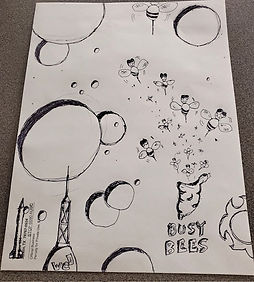
Nothing was better for a boy who, six years earlier, had lost his DNA homeland, and not long after, his entire family. A boy who wandered the playground unaccepted, marked by muscular dystrophy and a body that didn’t fit. In that classroom, with Mrs. Saylor’s voice and my pencil, I belonged somewhere—launched, finally, into a place of my own making.
Later teachers would scold me for “not paying attention,” catching me sketching rocket escape towers while lectures droned on. They never understood: I could still recite every word they said, every date, every equation. The drawings weren’t distraction; they were focus. Lines and shading became conduits, channeling complex ideas into something I could hold. The pencil kept my mind tethered to the lesson instead of drifting into the faces around me.
I hated being forced to stare forward, to lock eyes with teachers, whose private neuroses I could read in a blink, whose jagged imperfections—crooked teeth, twitching nerves, the way shame lived in their shoulders—would flood my thoughts until nothing else fit. Their faces became noise I couldn’t mute.
Even now, when I speak to folks, I close my eyes. Not to hide, but to draw the words in my head first—quiet lines on an inner page—so I don’t have to watch the feedback flicker across their faces: misunderstanding or worst…boredom.
In college I refined the trick: tiny, precise sketches tucked beside lecture notes. A rocket for Newton’s third law, an emerald river for market economics. During exams, I’d close my eyes, flip to the image in my head, and the entire lecture unspooled—word for word, slide for slide. The drawings weren’t crutches; they were keys.
That system became the spine of everything I paint. A single canvas can demand hundreds of hours, but the time never drags. I listen—always. Books on tape, now every streaming title I can queue. While the brush moves, voices fill the studio: history, biography, physics, myth. In the years I commuted to downtown L.A., I’d finish a book on the drive in, another on the crawl home, and still have bandwidth for three more while painting through the night. Three books a week, easy. The stories braid into the pigment; the pigment carries the stories.
I don’t just see the image—I hear the lecture that birthed it, feel the freeway vibration under the words, smell the acrylic mixing with the narrator’s cadence. Each stroke is a citation, each layer a footnote. The canvas is the test I never have to take again; the grade is the silence when someone finally stands in front of it and forgets to breathe.
The imagery evolved from lecture-note sketches to acrylic on canvas paintings in the mid-1980s, a shift that felt less like a choice and more like a summons. I was wrestling with psychological fractures I couldn’t name aloud. I needed a psychiatrist but trusted none of them. So I asked the only one I believed in: the Great Physician. I spoke the request into the dark, half plea, half dare prayer to my Father in heaven.
The help came the next few weeks in a general-education class. The assignment was simple: visit the Newport Harbor Art Museum (now the Orange County Museum of Art). The Big Bank, where I’d land a job a few years later, was sponsoring a split exhibition. One half of the gallery belonged to Matisse’s Jazz Series…the other half exploded with eclectic Pop Art: Warhol, Lichtenstein, Rosenquist—bold, flat, unapologetic. A single wall divided them. You could not see one world while standing in the other.
I walked the Matisse Jazz Series, though the name stuck in my head like a wrong chord. One by one: cut paper, bold color, white ground. At first it felt like a cheat—construction paper on posterboard. It no way individually felt like historic magic. So I turned the corner into the Pop Art side: icons everywhere, Americana distilled into clean, comic-flat graphics, the same language I was drilling in design classes. I loved it instantly, the structure, the taste, the punch.


My future wife and I sat on a bench facing only the Jazz Series half. No Pop Art in sight. And then it hit—not piece by piece, but the whole sweep. Like cathedral glass seen from the nave: the series wasn’t meant to be separate collages; it was one long riff, a single stained window of sound made visible. The negative space between panels played the downbeat. I felt the rhythm in my sternum.
Three weeks later I woke knowing exactly what my hand had to do. The style arrived fully formed: Matisse’s Cathedral flats mixed with Pop Art America, now fused in acrylic on canvas large format paintings. Cut-paper energy without the paper. Narrative arcs that read across a single canvas. I didn’t invent it; I translated it—cathedral light into pigment, playground exile into horizon.
Three weeks after the show, I woke with the painting already finished in my head—no blank canvas, no trial strokes, just the whole thing glowing behind my eyes. Daddy’s Love Truck. My first true canvas in the style that would become mine alone: a fusion of Matisse’s cut-out rhythm and Pop Arts brash clarity, a surface that could hold a story the way a lecture note once held a rocket.

I painted it in one fevered month, books on tape rolling in the background—The Right Stuff, The Fountainhead, voices layering over pigment the way Mrs. Saylor’s once layered over pencil. The truck itself was my father’s ’78 Ford, (brand new at the time) two-toned brown and white, like one of his prized Morgan horses. In the painting, its cannon blaring, lifted off the ground, wheels spinning, hauling a payload of everything I’d lost: homeland, family, the playground’s cruel geometry. Every stroke was a session on the couch I never booked. Every color, a confession of my father’s sins.
When the last paint dried, I stepped back and felt the fracture inside me knit—not healed, but held. The Great Physician had kept the appointment after all. One canvas, one answered prayer, the first of decades of therapy while listening to thousands of books filled with other artist’s therapeutic voices with their want or will to completely dissect a subject thoroughly.
The seed of originality was planted in that same general-education art class, the one that sent us to Newport Beach. The professor name was Jacobson (haircut like a Three Stooges bowl cut: straight, rich, sheared in a perfect line at the bowl’s rim). One lecture I’ll never forget: he split Picasso’s Guernica across two massive silver screens, left half on the left wall, right half on the right. I sat in the back, flanked by those screaming fragments (bull, horse, lightbulb, broken sword), the room itself a wound.
Then Jacobson said the words that lodged like shrapnel: “ the artworld puts a premium on an original idea.”
A decade later, after twenty canvases, I finished one without realizing what I’d done. The painting was Guernica’s left half (my style, my palette, but unmistakable). The left half? Pure me: abstracted conflict, horse charging through bureaucratic red tape, I hadn’t planned the homage. It just happened. Subconscious citation. Conversation across time.
I laughed out loud in the studio. Jacobson’s voice echoed off the paint: Originality is conversation. And there it was (half Picasso, half me), proof that the seed had grown into something neither of us could have predicted.


It’s a tribute to the subconscious mind and its quiet, relentless power. Most artists live in that current—odd, uninvited flashes that arrive fully formed, like messages from a deeper self. The culture at large shrugs it off, calls it coincidence, but I know the magic when I feel it. Roger Waters is the high priest of that realm. Take The Dark Side of the Moon—he swears he never intended it to sync with The Wizard of Oz, yet drop the needle at the third MGM lion roar and the album becomes a shadow soundtrack: “Money” chimes as Dorothy steps onto the yellow brick, “Time” ticks while the Scarecrow sings about brains. Pure subconscious genius, a cosmic accident that feels engineered by fate. Then there’s his, Amused to Death (1992). Sit with it from start to finish and you realize he’s woven a single, airtight concept: television as the new opiate, war as entertainment, humanity scrolling past its own extinction. It’s so complete, so layered, that a thousand listens still peel back new meaning. Absolute genius—not the kind you plan, but the kind that’s deep inside and ekes its way out and betters' mankind forever. In the decades after Daddy’s Love Truck, that first canvas became the seed of a lifelong therapeutic arc—subconscious visualizations of brokenness, inheritance, and escape. The Sins of the Father series, then my, Test or Rest Series, revisited the truck not as nostalgia, but as a cracked mirror: a father’s pride, his failures, the weight passed down like a rusted chassis. I painted the sins not to accuse, but to unload them—each layer a confession, each highlight a release.
Then came the Wilderness Walk series, where I returned, full circle, to fifth grade. The old wooden towers rising in those paintings? They’re not abstract—they’re the Apollo escape towers, the skeletal spires bolted above the capsule, meant to rocket the crew clear if flames erupted on the pad. I can’t imagine it ever working in real life—three men blasting up a pole in the final seconds before doom—but that’s the point: a last-ditch hope in the face of catastrophe. A strange, beautiful delusion of rescue.


You’ll see it everywhere in the works: lift-off. Not just rockets, but bridges leaping, dollar denominations ascending, figures suspended mid-air, caught between earth and ether. One painting even used a National Geographic Magazine’s book from 1962 cover of John Glenn’s first orbits—letters screaming “LIFTOFF” across the bottom of the canvas. It’s not subtle. It’s not meant to be.
Because that’s the through-line of my life: this place, in its current condition, is not my home. I was born into motion—a constant migration my DNA blasted from Palatine Germany to Rotterdam, Holland; from the colonies in New Jersey to Ontario, Canada; from Southern California to Austin, Texas. My ancestors fled, settled, fled again. My body—marked by muscular dystrophy—never quite fit the ground it stood on. My soul, shaped by Mrs. Saylor’s voice and Apollo dreams, was always pointed up.
So I paint the orbit. I paint the launch. I paint the moment just before escape—because that’s where I live. Not in arrival, but in ascent. One day, I believe, the Divine Appointment Vehicle will finally break atmosphere. Until then, I circle back, again and again, to the same christian hymn of my youth; This world is not my home / I'm just a passing thru / My treasures are laid up / somewhere beyond the blue.