top of page
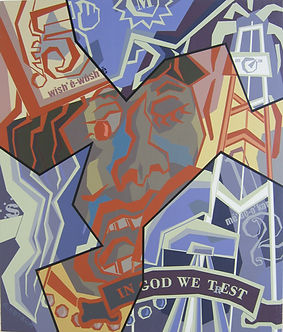

Mediocrity
(From my Book: Art & Synchronicity as Daytime Dreams)“
Mediocrity (a painting about halves) features a woman screaming at the center of the canvas, with the exact midpoint aligned at the tip of her nose, creating perfect symmetry: one half of her face on each side of the painting, one eye open and the other closed. Pearls encircle her neck, symbolizing a life of resolved conflict. Above her head floats a $0.50 bill marked with an “M” for the Federal Reserve Bank—the letter that begins the word “mediocrity,” and is midway through the alphabet. Beneath the 0.50 on the bill appears the word “wishy-washy,” neatly bisecting itself while evoking a milquetoast, indecisive lifestyle—neither here nor there, just bland nothingness. Encircling the $0.50 are hands in opposition: one pushing away, the other grasping. On the left side of her face, hair cascades down, flanked by the letter “S” for salt, implying reliance on superstition (like tossing salt over the shoulder for luck) instead of hard work—another wishy-washy notion. To the right, the scene evokes diligence with an oil rig relentlessly pumping the ground for wealth, paired with a switch in the upper part of the rig that toggles on or off, suggesting hard work’s inconsistent rewards; even with the switch off, the rig’s tower still yields riches. At the rig’s core lies the equation 1÷2—a metaphor for “half”—cleaved by the division sign, spelling out “mediocrity,” which perfectly separates the 1 from the 2. This entire composition reflects a pivotal time in my life when I couldn’t decide whether to continue squeezing art production into a hectic lifestyle or to quit altogether. It’s the dilemma most artists face, especially those balancing traditional family life obligations. In the bottom right corner, a lingering question looms: Do I have faith that God will guide me, or am I constantly testing Him? This dilemma is conveyed through a sleight-of-hand twist on the U.S. currency motto “In God We Trust,” whimsically altered to “In God We Test” or “In God We Rest.” Ultimately, this painting depicts ebbs and flows, where “mediocrity” literally means being halfway up a mountain—a juncture where serious questions arise: Do I continue and strive for the top, or do I retreat back down?
Days after I finished painting, I randomly watched the film “Seven Years in Tibet,” adapted from Heinrich Harrer’s memoir, unfolds as a metaphorical ascent up a mountain of personal and spiritual growth—mirroring the profound themes in my painting “Mediocrity.” From the beginning, once again, I could feel the sensation in my sinuses to perk up and listen—this movie has purpose. It begins with the arrogant Austrian mountaineer Harrer attempting to conquer Nanga Parbat in 1939, reaching a perilous halfway point fraught with conflict and ego-driven tensions among his team—symbolizing the initial hubris of ambition without deeper purpose, much like the mediocre stasis depicted in the painting. World War II intervenes, leading to his capture and imprisonment in a British POW camp in India, derailing the physical climb and forcing a troubled detour into isolation and self-reflection.
Escaping the prison with Peter Aufschnaiter, they endure a grueling wilderness trek across the unforgiving Himalayas, a journey so harrowing that, upon stumbling into the forbidden city of Lhasa, Tibetan officials—impressed by their sheer survival against terrain no one else could withstand—grant the feared outsiders asylum despite initial suspicions. This marks a pivotal shift: the “halfway” mediocrity of the failed summit gives way to trials of the spirit, as Harrer immerses in Tibetan culture, befriends the young Dalai Lama, and tutors him on Western knowledge while absorbing Buddhist wisdom that humbles his former selfishness.
The narrative builds amid the ebbs and flows of inner transformation, culminating in a profound metaphorical climax during the 1950 Chinese invasion that shatters Tibet’s serenity and forces Harrer’s reluctant departure. Through these adversities—the relentless wilderness ordeal, the cultural immersion, and the geopolitical upheaval—Harrer metaphorically resumes his stalled climb, battling internal storms and external chaos to ascend beyond the clouds of doubt. At the enlightened summit, bathed in the radiant dawn of self-realization, he “plants the flag” after profound change—a triumphant peak far transcending the icy physical heights he once pursued, where the view reveals not conquest, but harmony with the world below. Ultimately, he is able, through all his conflicts, to restart the ascent from that midway point this time with his son at his side and makes it to the peak, echoing my painting’s invitation to transcend mediocrity through faith, perseverance, and purpose.
Strangely enough, the day after I immersed myself in this cinematic odyssey, fate guided me through a neighborhood, where winding streets dissolved into the vast playground of an intermediate school—like a forgotten realm emerging from the mist. In this cul-de-sac, homes stood as sentinels, each adorned with flags of distant nations fluttering like whispers from the world’s far corners. I stood transfixed by the serendipity: as Harrer planted his emblem atop the peak, so too did these banners proliferate around me, a chorus of colors heralding that the film was no mere entertainment, but a clarion call demanding my soul’s attention. I embraced it deeply, envisioning my own summit shimmering on the horizon, oblivious then to the shadowed wilderness that awaited—a protracted pilgrimage akin to Harrer’s, fraught with tempests of the spirit, where every step forged resilience from raw endurance.
bottom of page